MR. MORRIS TEACHING TODAY - Mrs. Donnelly administering quiz!
If you are an Honors student: you need to see Mr. Morris about your writing assignment ASAP!!!
Main idea: A Renaissance man (or woman!) is some one who excels at all thins. Such a person is literally one in millions. However, that doesn't mean we can't all attempt to become one.
WWK:
Renaissance Man or Woman: a person who excels (does good at) all things.
Arete: (think back to first trimester) Greek belief in living up to one's full potential.
Ideal: (Plato's Allegory of the Cave) theory of forms. For everything on Earth, there is an ieal or perfect form. All others are reflections.
Humanism: using reason, man can unlock the secrets of the universe.
Leonardo da Vinci: the ultimate Renaissance Man - good at everything.
Polymath: a person who knows many areas of knowledge and can combine these to solve difficult problems. Note: this is the original term for Renaissance man.
Another really nice mask, made with craft foam paper and paints with a creeptastic picture of the maker wearing it. (I'm working on my own version of this one right now!) Link here.
A second mask with craft foam as the base, but covered in fabric rather than paint. Does require some stitching. Link here.
A leather and goggles version - for those of you who want to be a little more gothic: link here.
And one last paper mache and foam version. This is really similar to the project I did when I was in high school... lots of fun, but can get messy! Click here.
Hopefully that gets your creative juices flowing! If you have any questions, please feel free to ask me. I have also seen these made out of plaster, duct tape, and metal working... the sky's the limit!
As many students have submitted proposals for edible projects, I did some googling and found some pretty awesome inspiration! Take a look at the cookie, cake, and other food related project ideas I've found!
Welcome to Mrs. Donnelly's Third Trimester World History!
For those of you I met last trimester, welcome back!
If you're a new student (or parent!) let me give you a quick tour.
TABS ABOVE:
Classroom guidelines - explains expectations, rules, required materials and missing / late policies.
Interactive Notebooks - we do notes and assignments in class a bit differently than you may be used to. YOU ARE REQUIRED TO HAVE A NOTEBOOK IN CLASS AND IT IS ABOUT 50% OF YOU GRADE. Please familiarize yourself with the information above and ask me if there are any questions.
Daily Journals - all journal prompts are listed. These are (almost) daily mini-writing assignments. If you're absent or missing a journal, check there!
Homework assignments - any and all active or past homework assignments will be listed here. I try to keep homework to a minimum, but expect homework a couple times a month. Be aware any notebook work not finished in class is the responsibility of the student and must be completed at home.
About the teacher - info about me, my degrees, and tidbits about me!
Additional information you need to know:
All students are required to complete a trimester project.
All honors students are required to also complete book project.
I am available everyday before school, during lunch, and after school (later than 4:00 requires appointment). ASK ME FOR HELP! I am more than willing to help you succeed!
I am willing to provide "Freedom" tickets for classroom supplies such as tape, kleenex, or clorox wipes. These may be used for late assignment forgiveness, extra credit, or notebook assignment waivers.
Prior to test dates, I post extra credit here on the website!
If you need to contact me, please feel free! Contact info is in the course guidelines.
Today we're learning backwards -- you'll work on inference -- making predictions based on evidence and then at the end of the class, we get the whole story. If you're confused in class, that's okay! We're trying to stretch our brains in a new way.
Main idea: Knights in the Middle Ages were highly trained and
followed a strict code of honor called chivalry. Queen Eleanor of Aquitaine started the idea of courtly love which meant ladies were treated with respect. Troubadors sang songs about courtly love.
Words Worth Knowing:
Squire – knight in training who helped the knight with his equipment
and horse, started at age 14
Page – a boy training to be a knight; started at age 7
Knight – a mounted, highly trained warrior known for his
loyalty and honor
Chivalry – Code of conduct an honor, courage and loyalty
adopted by Knights
Tournaments – a festival where knights could practice
fighting skills in fake battles
Courtly love - men should treat women with the highest honor and respect. Idea by Queen Eleanor of Aquitaine
Troubadours - musician who sang about courtly love Left side:
Document Work in class - this is an assignment so you need to see me to make it up.
Rubric for Coat of Arms: Total possible: 50 points
Shield (5 points)
Helmet/Headgear (5 points)
Wreath (5 points)
Crest/Plume (5 points)
Mantle (5 points)
Supports (2) (5 points)
Base (5 points)
War Cry (5 points)
Neatness (5 points)
Color (5 points)
Rubric for Writing Portion of Project: Using descriptive language, explain your coat of arms.
Total possible: 25 points
(This is for all students, not just honors!)
Descriptive Writing: using the five senses to describe what you are writing!
Select five components from your coat of arms.
One or two sentences per item: explain what they are and why you chose them. Use as many details as possible (this is what I'm looking for in this assignment).
Example: For my helmet, I chose a bright red, large apple with a green leaf. I picked an apple because rather than a soldier, I am a teacher and the apple is a symbol of education and in Medieval heraldry, the apple is a symbol of peace.
Watch this video if you are gone: Coats of Arms: Origins
For symbolic meanings of colors, shapes, animals, and objects, click here or here.
If you're needing the review sheet for the test (WEDS. FEB. 12th!!), please see below. If you need a hard copy, please let me know. All information should be in your notebooks or in the videos posted here on the website.
Remember, there is a Quizlet for all the WWK we've studied in class if you need something extra to review!
I haven't done any extra credit on the website for some time now, so for those of you who are interested:
Take a look at the following family tree of the Carolingian dynasty. Familiarize yourself with where the kings we've talked about in class and their ancestors.
Answer one of the following questions on a sheet of paper and turn it in with your name and hour. This will earn you extra credit towards your test score. Due on or before the day of the test!
How many ancestors of Charlemagne were named Louis? Are any famous kings of France named Louis?
Why is Clovis not on this family tree? (Think to what we've discussed in class.)
Do you think this is the entire Carolingian line? If so, why? If not, who's missing?
NOTE: You can click on the image to make it bigger if it is hard to read. :)
The Franks
were a Germanic tribe that helped spread Christianity, saved Europe from the
Muslims, and built a large empire. Monasteries
in Europe became more popular after St. Benedict wrote his Rules.
Words Worth Knowing
Franks
–
Germanic tribes that settled in France and united into one large kingdom.
Clovis
– Frankish leader who converted to Christianity and made all Franks Christian.
Charles
Martel – aka
“THE HAMMER” Frankish leader who won against Muslim invaders at the Battle of
Tours (732) and stopped the spread of Islam in Europe.
Monastery
– a community of monks who have taken religious vows. Often lived in seclusion
(apart from the world) and known for libraries and education. Women’s version
is a nunnery.
St. Benedict –
wrote rules for monks that spread through Europe.
We went over an MME and did a left hand side foldable (if you missed, see me for handout.) We also worked on maps and did a notebook check.
DAY TWO:
Main ideas:
Charlemagne
was the first western emperor since the fall of the Roman empire.
Charlemagne’s
empire fell apart after his death and was divided by the Treaty of Verdun.
Words Worth Knowing
Pepin – aka “THE SHORT” Frankish
leader who rescued the pope. The pope named him King of the Franks. (son of
Charles Martel)
Carolingian – family line of
Frankish Kings started by Pepin
Charlemagne – “THE
GREAT” was named Holy Roman Emperor and was the greatest ruler of the Middle
Ages.
Treaty of Verdun
- Charlemagne's large kingdom divided three ways among his grandsons, who lose
it.
For the review videos, we watched this one and this one. NOTE: somewhat graphic.
For the group DBQ and presentation make-up, see me in class.
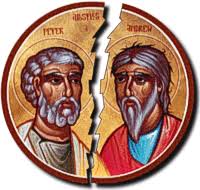
The Church divided into the Roman Catholic and Eastern Orthodox Churches in 1054.
The pope of the Roman Catholic Church played a greater role in government in the west than the leader (patriarch) of the Eastern Orthodox Church played in the east.
Words Worth Knowing (WWK)
§Schism - a split caused by differences in opinion or belief
§Eastern Orthodox Church – based in
eastern Constantinople, Greek language (or other), patriarch, icons. Orthodox
means “holding established beliefs.”
§Roman Catholic Church – based in Rome and
Europe, Latin language, pope, no icons allowed. Catholic means “universal.”
§Icon – a religious symbol used for
worship.
§Patriarch – leader of Eastern Orthodox
church, works with bishops under emperor
§Pope – leader or Roman Catholic church,
above bishops and emperor
§Cyrillic alphabet – alphabet developed in
Byzantine to translate Greek religious texts to Slavic speaking people. Still
used in Russia.
Resources
For a podcast on the Schism from a religious historian here.
For the Metropolitan Museum of Art's webpage of religious icons and history, visit here.
For an example and history of the Cyrillic alphabet, click here.
•Roman culture continued in the Byzantine Empire for a
thousand years after the fall
of Rome. They considered themselves Roman. •Emperor Justinian regained a lot of the old Roman
Empire and helped to preserve Roman law. He also helped restore Constantinople.
Words Worth Knowing:
•Byzantine
Empire – eastern Roman Empire that lasted 1,000 years after
the Western Empire fell (named after original city Byzantium)
•Justinian I – emperor of Byzantine and reconquered much of
the old Roman empire, aka Justinian the
Great
•Justinian Code
– Emperor Justinian took
400 years of Roman laws and combined them into one book of 5,000 laws.
This book was used for 900 years and is
the basis for some laws used today. (Included laws on marriage, slavery, property, womensrights, crime)
•Theodora – wife of
Justinian, saved his rule by telling him not to flee during a riot, very
influential during Justinian’s rule.
•Constantinople – center of the Byzantine Empire; most influential
city in Europe for 900 years.
•Hagia Sophia – church built by Justinian, greatest Christian church
in the east until it was turned into a mosque. Still stands today. Name means
“church of Holy Wisdom”
This video is a Crash Course on the Fall of Rome through the Byzantine Empire. If you were gone, it wouldn't hurt to watch all of it (12 minutes), but we watched the last 5 minutes in class.
For a quick run-down of Justinian I, check out this video!
Pages
IF YOU NEED HELP DECIDING WHAT GOES ON THE RIGHT AND LEFT SIDE INFO IN YOUR NOTEBOOK: CLICK HERE.
Justinian Code vs. American Code Foldable (Color the mosaic for extra points!)
Due to this being a foldable, please ask me for a copy in class if you need it.
Resources
Click here for a timeline of the entire Byzantine Empire.
Metropolitan Museum of Art's Byzantine Art History Timeline shows everything from mosaics to jewelry.
For a time-lapsed video of how the map of the Byzantine Empire changed over time, watch this video here.
For an online 360 degree tour of Hagia Sophia, visit here.
If you want more information about Theodora, visit this website.